
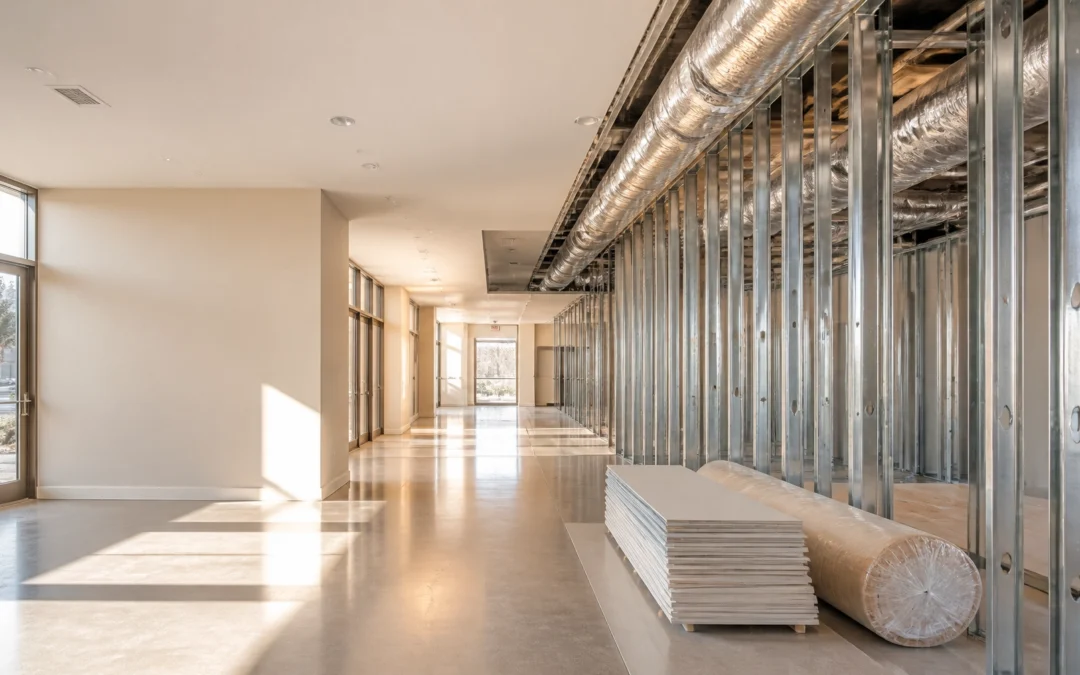
A fire or major water loss can make a commercial property feel beyond repair. Walls may be opened, ceilings removed, insulation exposed, and business operations interrupted. It is natural to wonder whether tearing everything down and starting over would be faster or more cost-effective.
In many cases, however, a full tear-down is not necessary.
When the building’s primary structure remains sound, targeted commercial restoration can often save money, shorten the construction timeline, and preserve valuable parts of the property. The key is making the decision based on a careful assessment: not on appearances alone.
For business owners in Central Arizona and Southern Arizona, Total Precision Builders helps evaluate and rebuild commercial spaces after fire and water damage. Our team combines restoration, remodeling, metal stud framing, drywall installation, and general construction experience to create a practical path forward.
Restoration begins with an expert assessment
Before deciding between repair and rebuilding, the property needs to be stabilized and evaluated.
After a fire, that may include smoke, soot, heat, firefighting water, damaged electrical systems, and weakened materials. After a water loss, the concerns may include saturated drywall, damaged insulation, corrosion, hidden moisture, and mold growth.
The first steps should include:
- Confirming that the building is safe to enter
- Identifying the source of the water and stopping further damage
- Documenting affected areas with photographs and written notes
- Testing moisture levels in walls, floors, and ceilings
- Inspecting framing, roof systems, floors, and other structural components
- Determining whether smoke or water reached concealed spaces
- Reviewing code, fire-rating, accessibility, and permit requirements
- Coordinating with the property owner, insurance representatives, engineers, and other professionals
A commercial restoration contractor can help define the construction scope, but structural concerns should be reviewed by the appropriate licensed professionals. The goal is to distinguish between materials that must be removed and building components that can be safely preserved.
This distinction is where restoration can offer a significant advantage.
Why a full tear-down is not always the best answer
A full rebuild involves much more than removing damaged walls. It may require demolition, hauling, engineering, new plans, extensive permitting, utility replacement, site work, inspections, and the reconstruction of areas that were never damaged in the first place.
If the fire or water damage is limited to certain rooms, wall lines, ceilings, or sections of the building, tearing down the entire interior can create unnecessary costs.
Targeted restoration may allow you to:
- Preserve the existing foundation and primary structure
- Keep undamaged sections of the building intact
- Replace only compromised framing and finishes
- Reduce demolition and disposal costs
- Reuse existing layouts, utilities, and infrastructure where appropriate
- Reopen portions of the business sooner
- Avoid the disruption of a complete redesign
- Make improvements while the affected areas are already open
This does not mean every damaged material should be saved. Fire-damaged drywall, heavily saturated gypsum board, corroded framing, and unsafe components generally need to be removed. Restoration means being selective and strategic: not taking shortcuts.
Drywall damage: remove what is compromised, preserve what is sound
Drywall is one of the first materials to show the effects of fire and water damage. It can become stained, swollen, softened, delaminated, or contaminated by smoke and soot.
In many situations, damaged drywall is removed back to the studs. This exposes the wall cavity so the framing, insulation, electrical components, plumbing, and other concealed elements can be inspected.
Drywall often needs replacement when it is:
- Burned, charred, or structurally weakened
- Saturated for an extended period
- Swollen or separating from its paper facing
- Contaminated by mold or persistent odors
- Part of a damaged fire-rated wall or ceiling assembly
- Covered with smoke residue that cannot be effectively cleaned and sealed
On the other hand, drywall outside the affected area may not need to be removed. If it is dry, stable, cleanable, and not part of a compromised rated assembly, it may be possible to preserve it.
The final decision depends on the material’s condition and its role in the building. For example, a smoke-affected partition may require cleaning and sealing, while a wall designed to provide fire separation may need a carefully reconstructed rated assembly.
Replacing only the damaged drywall can help reduce both material and labor costs while maintaining a professional finished appearance.

Metal stud framing can often be repaired selectively
Metal stud framing is common in commercial interiors because it supports efficient layouts, durable partitions, and fire-rated wall assemblies. After water or fire damage, the condition of each stud, track, connector, and fastener should be evaluated.
Water exposure does not automatically mean every metal stud must be replaced. If framing is straight, secure, properly aligned, and free from significant corrosion, it may be possible to retain it after the wall cavity is dried and inspected.
However, framing may need to be removed and replaced if it shows:
- Buckling, twisting, bowing, or other deformation
- Heat-related distortion
- Severe corrosion
- Loose or failed connections
- Damaged tracks or fasteners
- Loss of alignment that prevents proper drywall installation
- Conditions that compromise a fire-rated or structural assembly
Heat can affect metal framing even when the damage is not immediately obvious. A stud that looks mostly intact may still require professional evaluation if it was exposed to intense fire or prolonged heat.
Load-bearing metal framing, structural walls, and framing connected to the building’s primary systems require particular care. These areas should be assessed by qualified design or engineering professionals before repair work proceeds.
For non-load-bearing partitions, selective reconstruction is often practical. A damaged section can be removed, new studs can be installed, and the wall can be rebuilt without disturbing unaffected areas.
That is one of the ways specialized metal stud framing experience can save time during a commercial restoration project.
Restoration can shorten the path back to business
For most business owners, the cost of construction is only part of the financial impact of a fire or water loss. Every day a facility is closed can affect employees, customers, inventory, equipment, and revenue.
A targeted restoration approach may support a faster recovery by focusing work on the areas that need it most. Depending on the property and the damage, construction may be phased so that unaffected portions can be cleaned, inspected, and returned to use while reconstruction continues elsewhere.
A typical process may include:
- Secure and stabilize the property. Confirm safe access and address immediate hazards.
- Stop the source of damage. Shut off water, protect openings, and prevent additional exposure.
- Document conditions. Record damage before demolition and coordinate with insurance representatives.
- Remove unsalvageable materials. Open affected walls and ceilings as needed.
- Dry, clean, and treat the space. Address moisture, smoke, soot, odors, and contamination.
- Inspect framing and concealed systems. Repair or replace metal studs, tracks, insulation, and other affected components.
- Reconstruct walls and ceilings. Install drywall and complete rated assemblies according to approved requirements.
- Restore finishes and business functionality. Complete flooring, paint, millwork, fixtures, and related improvements.
- Complete inspections and final checks. Confirm the space is ready for reoccupancy.
The timeline varies based on the extent of the loss, permitting, material availability, engineering requirements, and insurance coordination. Still, avoiding unnecessary demolition can make a meaningful difference.
Repair or rebuild? A practical comparison
| Consideration | Targeted restoration | Tear-down and major rebuild |
|---|---|---|
| Best fit | Localized damage with sound primary structure | Widespread damage to major structural or building systems |
| Demolition | Limited to affected areas | Extensive removal throughout the property |
| Framing | Replace damaged sections and retain sound areas when appropriate | Reframe most or all interior areas |
| Drywall | Remove and replace compromised walls and ceilings | Replace large portions or the entire interior finish system |
| Business interruption | May allow phased work or earlier reopening | Usually requires a longer full-property closure |
| Cost control | Preserves undamaged construction | Includes the cost of replacing unaffected areas |
| Design flexibility | Can include upgrades during repairs | Allows a full redesign but requires a larger investment |
The right choice depends on the assessment. A property with extensive structural damage may require major reconstruction. But if the foundation, primary structure, and most of the building systems remain viable, restoration is often the more responsible financial decision.

Restoration is also an opportunity to improve the space
A restoration project does not have to mean returning the property to exactly the way it was before the loss.
Once walls are open, business owners may be able to address long-standing issues or make carefully planned improvements, such as:
- Reconfiguring an inefficient office or retail layout
- Improving storage and circulation
- Upgrading lighting or finishes
- Adding durable wall protection in high-traffic areas
- Improving insulation or sound control
- Updating a reception area, restroom, or customer-facing space
- Coordinating repairs with a planned tenant improvement
This is where restoration and remodeling experience work together. A contractor who understands both damage recovery and commercial construction can help identify practical improvements without turning a focused repair into an uncontrolled renovation.
At Total Precision Builders, we provide commercial construction services backed by more than 25 years of experience. Our licensed, bonded, and insured team offers commercial remodeling and tenant improvement services, metal stud framing, drywall, additions, new construction, and commercial restoration.
A smarter path forward after commercial damage
Fire and water damage are stressful, but a damaged commercial space is not automatically a lost building. With the right assessment, it may be possible to preserve the structure, replace only what is compromised, and restore the property faster and more affordably than a full tear-down.
The most important step is to avoid making a major demolition decision before the building has been properly evaluated. A thoughtful restoration plan can protect your investment, reduce unnecessary work, and help you return to serving your customers.
If your commercial property in Central Arizona or Southern Arizona has experienced fire or water damage, contact Total Precision Builders to discuss your next steps. We can help you understand the construction process and develop a practical plan for restoration, remodeling, framing, and drywall work.
